The Trip in Numbers
3,236 miles
n gallons of gas
7 national parks, monuments, preserves – Hagerman Fossil Beds NM (ID), Craters of the Moon NM (ID), Grand Teton NP (WY), Yellowstone NP (WY), Dinosaur NM (UT), Fossil Butte NM (WY), Joshua Tree NP (CA)
4 state parks – Berlin-Ichtiosaur SP (NV), Anza-Borego SP (CA), Thousand Springs SP (ID), Niagara Springs SP (ID)
13 nights
14 days
7 states – California, Nevada, Idaho, Wyoming, Montana, Utah, Arizona
n archeological sites – Legend Rock Petroglyph site and Medicine Lodge Archeological Site (both are near Termopolis, WY),
Temple Mountain Wash Pictograph Panel (UT), Black Dragon pictograph (UT), Rochester Panel (UT),
5 fossil sites – Hagerman Fossil Beds NM (ID), Ichthyosaur Fossil Shelter (Austin, NV), Jurassic wall at the Dinosaur National Park Quarry Cliff, Wyoming Dinosaur Center (Thermopolis, WY), the Eocene deposits of Fossil Lake (Fossil Butte NM, WY)
4 soaking mineral hot springs – Hot Springs SP (Termopolis, WY), Yellowstone Hot Springs (Gardiner, MT), Miracle Hot Springs (Buhl, ID), Red Hill Hot Springs (Monroe, UT)
n wild mammals saw – grizzly bear, black bear, golden-mantled ground squirrel, red squirrel, least chipmunk, yellow-bellied marmot, elk, moose, mule deer, bighorn sheep, bison, pronghorn…
Everyone knows the basic premise of a geological unconformity: it represents a profound gap in the geological record, where a massive stretch of time, history, and evidence has been completely erased between two sequential rock layers.
Our fascination with these temporal blind spots started close to home. We first stood on and touched one at Torrey Pines State Park, where a 40-million-year-old Eocene stone layer (an ancient ocean floor) is capped directly by 2-million-year-old Pleistocene sandstone. Having 38 million years of history completely missing right under your fingertips is an incredible feeling. Later, we tracked down another massive gap in Petrified Forest National Park (AZ), where roughly 250 million years of layers are missing. Then came the famous Great Unconformity in the Grand Canyon—a staggering 1.2-billion-year leap between the 1.7-billion-year-old Vishnu basement rocks and the overlying Paleozoic sedimentary strata.
But then we learned about an even wider, more extreme gap—the “Hyper” Great Unconformity, right here in the Western US.
The initial inspiration for this massive road trip was a deep-dive YouTube video detailing a mind-bending 2-billion-year unconformity and pointing out the exact, precise locations where you can drive up, see it, and physically touch it. The biggest hurdle was the pure logistics: both prime spots are located deep in Wyoming.
To make the grueling mileage worth it, we designed an expansive loop combining these geological anomalies with Craters of the Moon, Yellowstone National Park, and a dozen equally compelling detours across the Northwest. We targeted late May to early June as the sweet spot for the trip. The strategy paid off: the heavy summer crowds hadn’t arrived yet, the weather was comfortably transitioning out of the mountain cold without being sweltering, and it was a prime window for wildlife viewing (where the local bears are out and active, but not yet desperately hungry or overly aggressive).
A Journey Along the Yellowstone Hotspot Track
We intentionally designed our route across the American Northwest to trace one of the most violent and awe-inspiring geological features on Earth: the Yellowstone Hotspot Track. It is the chain of volcanic calderas and related geologic features left behind as the North American plate moved over a relatively stationary “supervoulcano” hotspot. The Earth’s crust has been moving across a stationary mantle plume (a deep column of superheated rock rising from Earth’s core-mantle boundary). While the hotspot plume itself stayed firmly fixed, the North American continental crust drifted slowly over it toward the southwest at a rate of about 1 inch per year.
As illustrated in details in the terrain mapping below, today the Yellowstone mantle plume sits directly beneath Yellowstone National Park. Tracking backward along our route, the active volcanic center sat at the Idaho-Wyoming border 1.3 million years ago (Ma), beneath Craters of the Moon 7–10 Ma, near Twin Falls 10–12 Ma, and at the Idaho-Nevada-Oregon tri-state point 13–15 Ma. It originated at the McDermitt caldera complex on the Nevada-Oregon border, the oldest remnants of this volcanic line originated 16.5 to 15 million years ago (Ma) near the tri-state junction of Nevada, Oregon, and Idaho and which is a very prominent destination point for one of our future trip. Over millions of years, the scar moved across Idaho, marking the positions where the hotspot burned through the crust: the Bruneau-Jarbidge caldera complex at 12–10.5 Ma, the Twin Falls volcanic field at 10.5–8.6 Ma, the Picabo field at 10–7 Ma, and the Heise volcanic center at 6.5–4.3 Ma. Today, the engine sits directly beneath Yellowstone National Park, but the ancient centers left behind experienced subsequent geological forces that completely reshaped the landscape.
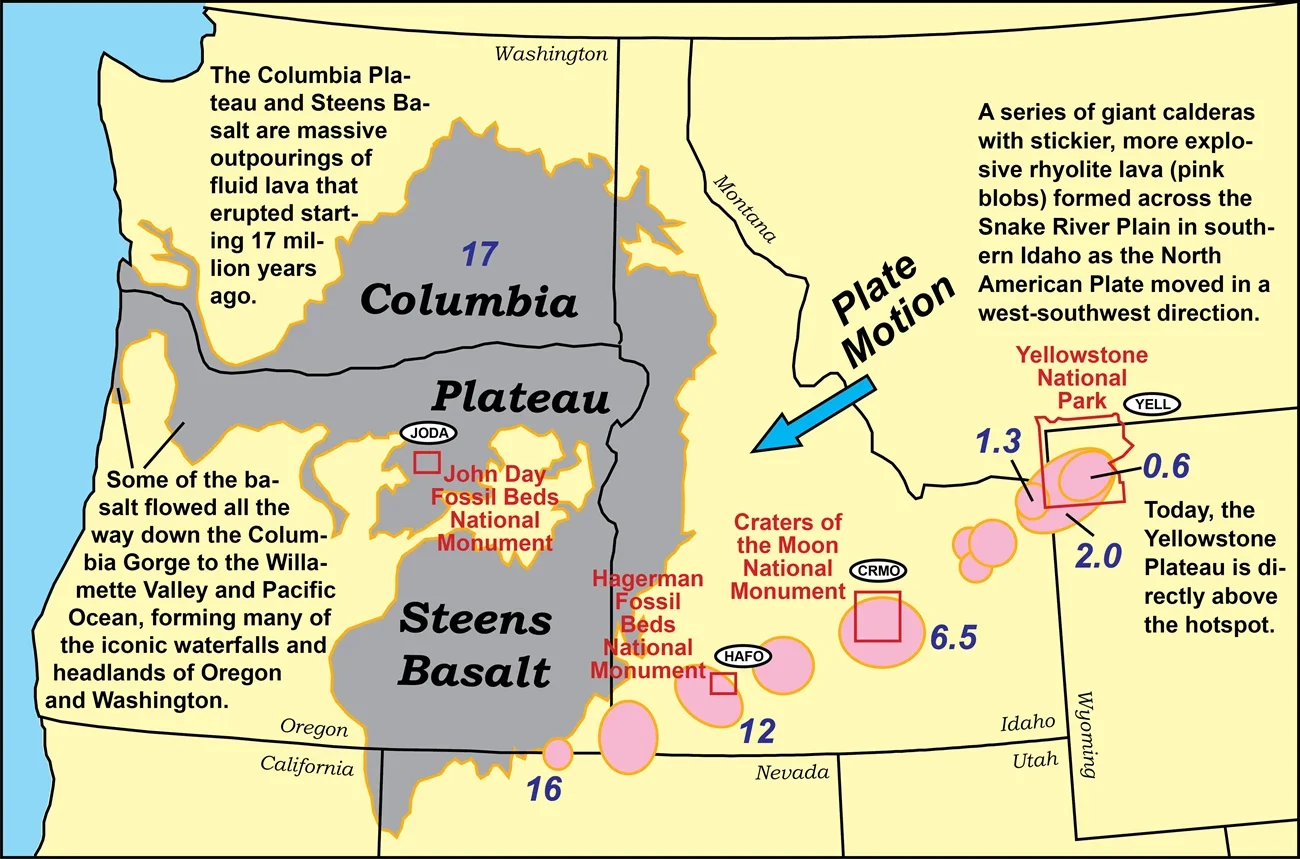
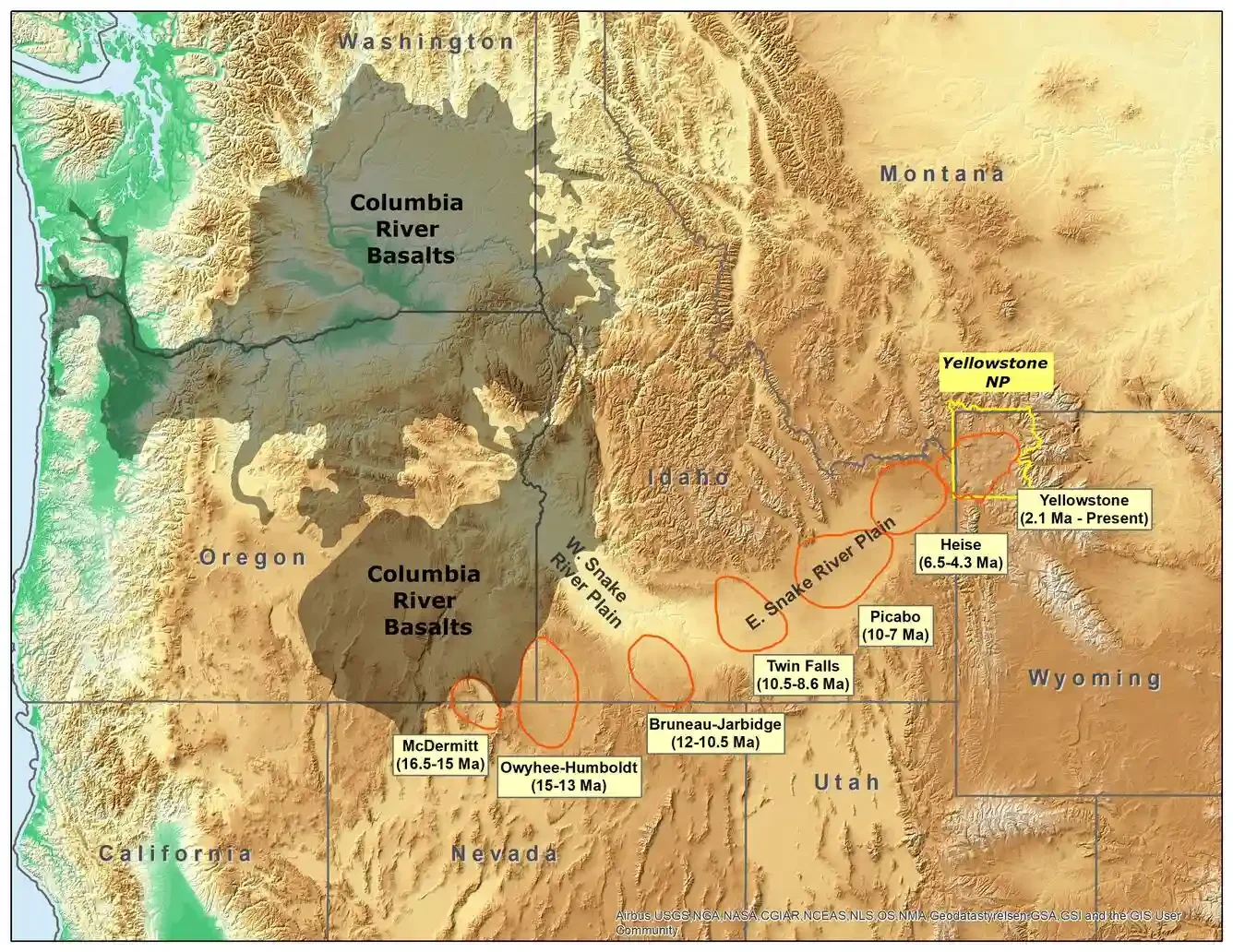
While the volcanic engine underneath stays firmly fixed in space, the continental crust glides across it toward the southwest at a rate of approximately 1 inch per year. Traveling from southwest to northeast along our trail meant traveling forward through volcanic time.
The Western Edge: Eureka & The Thousand Springs Region
Regional Geology & Stratigraphy
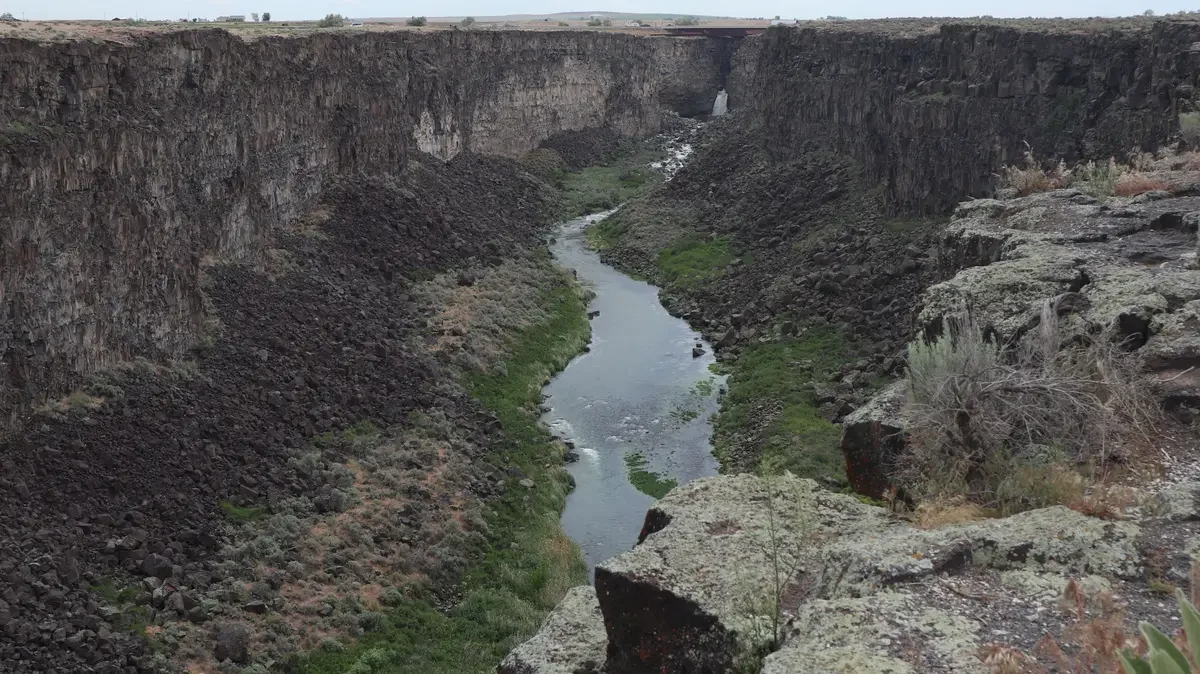
Our first primary encounter with the aftermath of this system was the Western Snake River Plain near the Thousand Springs region. Roughly 10 to 12 million years ago, this very landscape sat directly above the main mantle plume, enduring massive rhyolitic “super-eruptions.” Rhyolite is a highly viscous, silica-rich volcanic rock that traps volcanic gases, leading to explosive, caldera-clearing events.
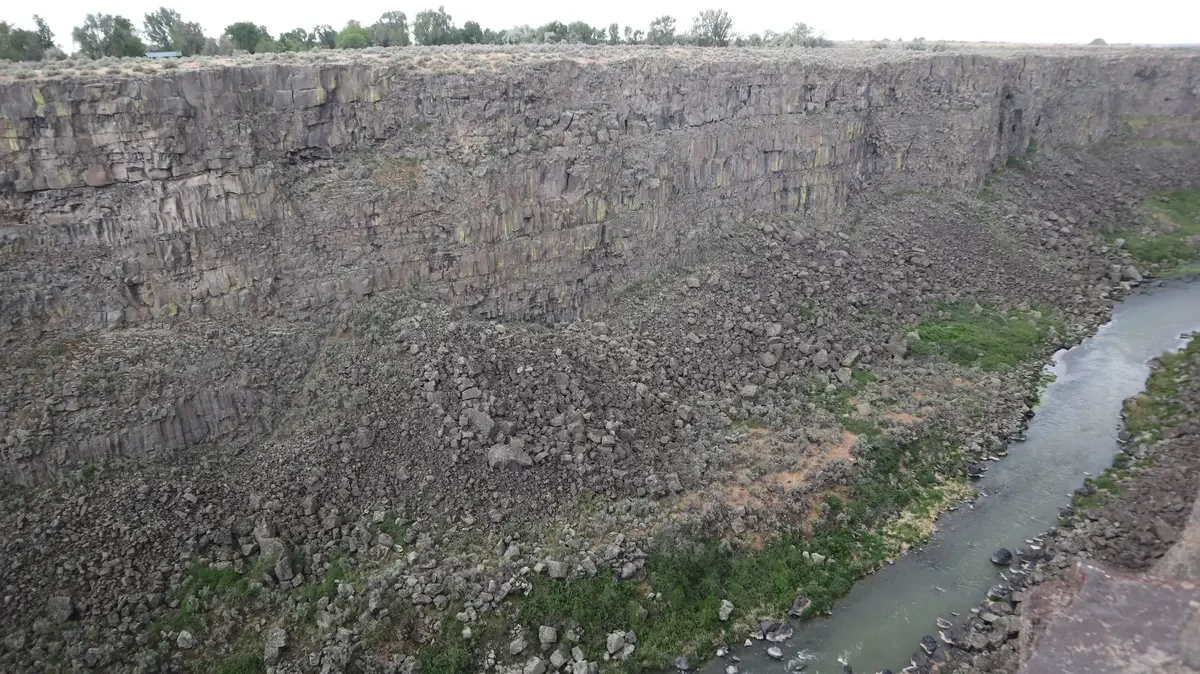
However, after the main plume passed, the region underwent structural failure. Regional tectonic forces pulled the crust apart, creating a graben—a depressed block of land bordered by parallel faults. This structural trough later filled with highly porous layers of post-hotspot basaltic lava flows spilling from small, local volcanic fissures.
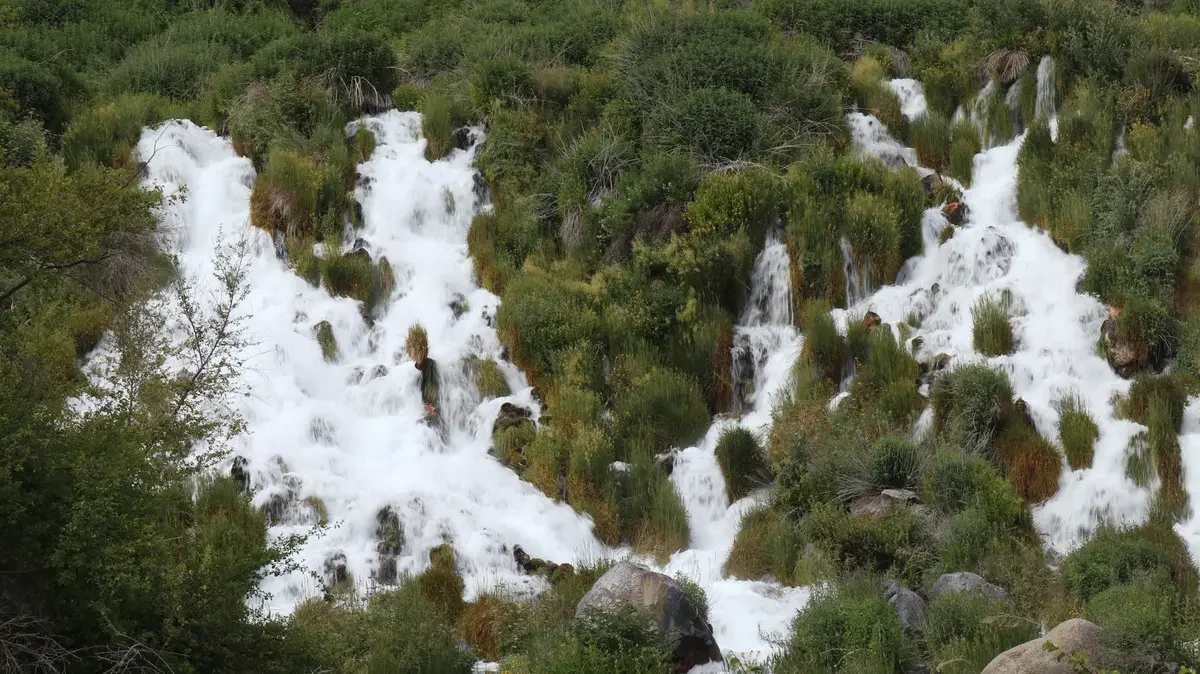
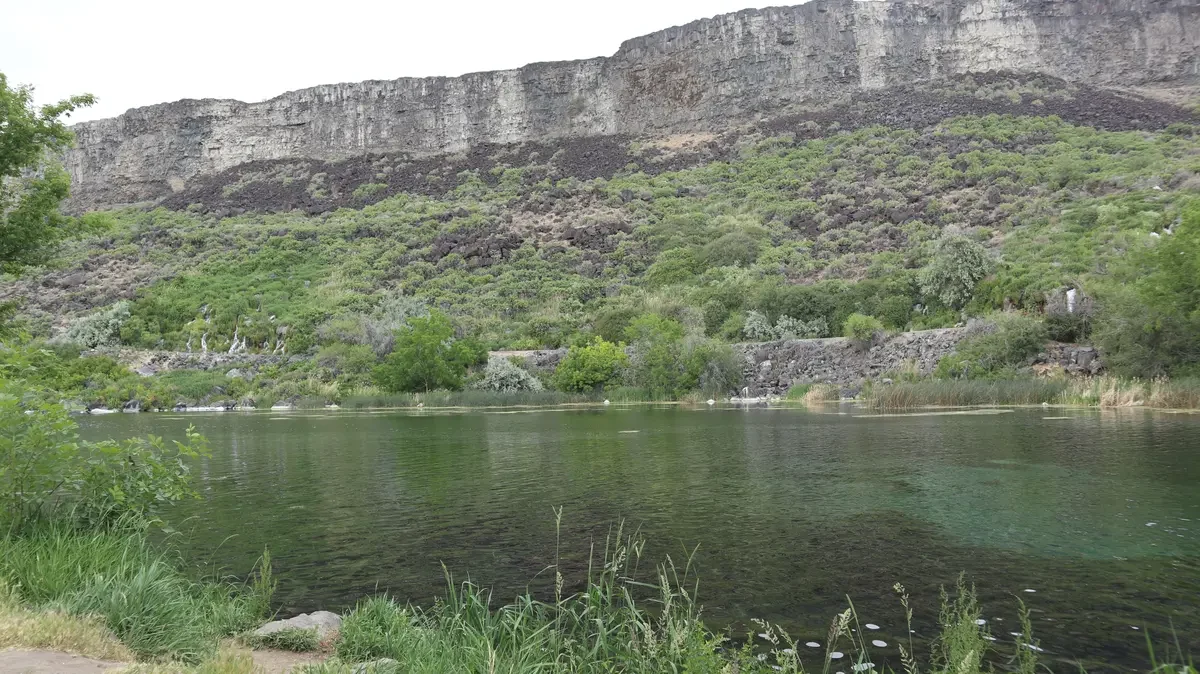
During the late Pleistocene glacial epochs, catastrophic megafloods ripped through the valley. These raging torrents carved deep, sheer vertical trenches into the brittle basalt layers, exposing sites like the dramatic Malad Gorge. Today, the vast Snake River Plain Aquifer discharges its icy groundwater directly out of these bare canyon walls, creating a striking oasis where thousands of springs burst from dark basalt cliffs.
Anthropological & Indigenous History
This water-rich canyon network provided a critical sanctuary for the Numu (Northern Paiute) and Shoshone peoples. For millennia, these groups relied on the constant, non-freezing spring waters and deep basalt sheltered canyons for winter encampments, utilizing the unique local topography to trap game and harvest abundant salmon runs.
The Living Rift: Craters of the Moon
Regional Geology & Stratigraphy
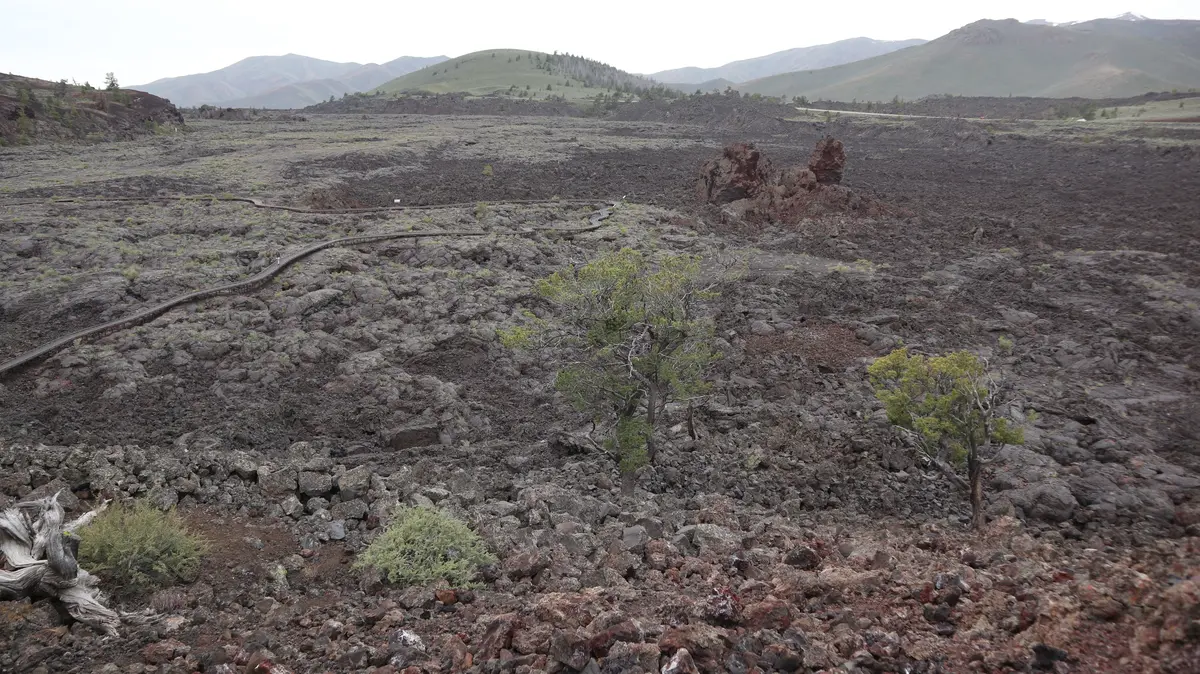
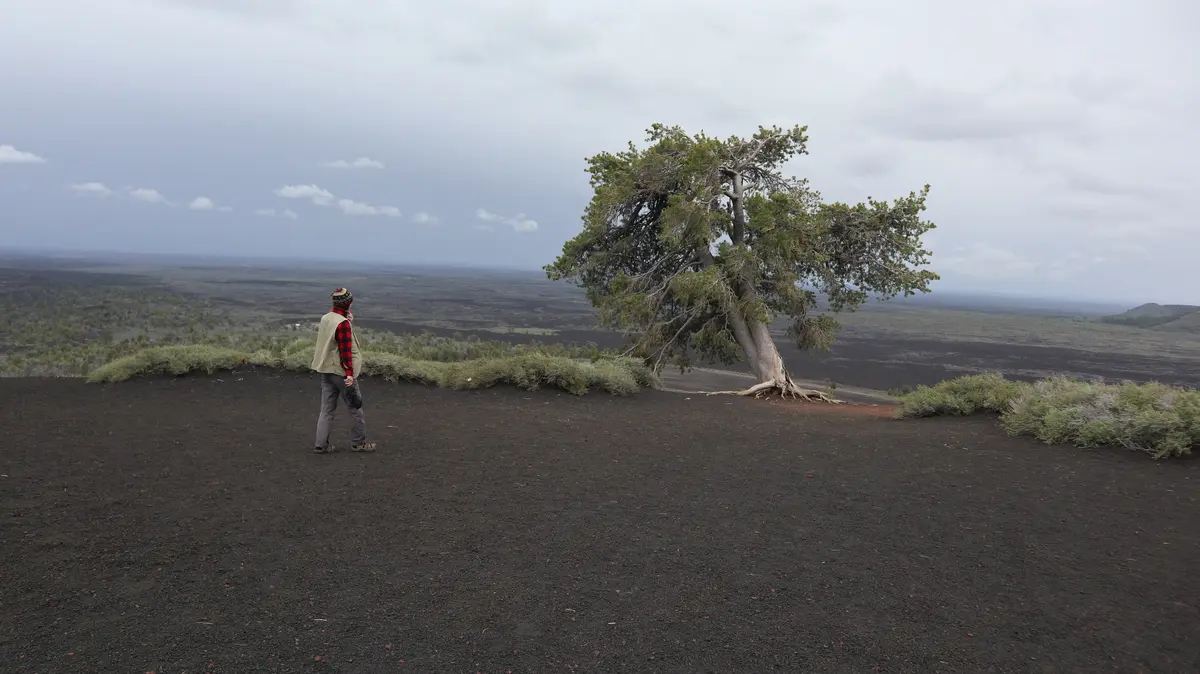
Moving northeast into the middle of the track brought us to Craters of the Moon National Monument, where the volcanic landscape shifts from ancient and buried to fresh and raw. Though the catastrophic rhyolitic hotspot engine passed this region nearly 10 to 7 million years ago (forming the deeply buried Picabo volcanic field), it left the continental crust permanently stretched, thinned, and fractured.
This profound crustal weakness allowed younger mantle magmas to rise to the surface along a 52-mile-long structural tear known as the Great Rift of Idaho. Over eight major eruptive periods spanning from 15,000 to just 2,000 years ago, fluid basaltic lavas welled up from deep fissures.
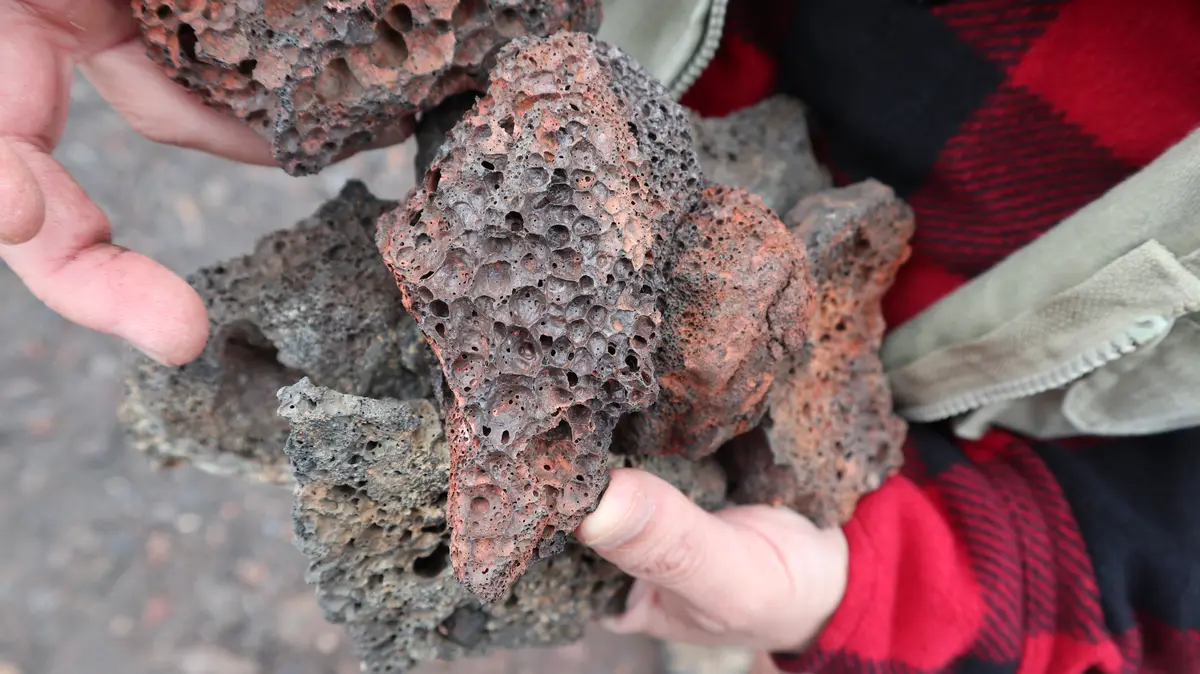
Walking across this park is like stepping onto an alien world. The landscape is dominated by stark cinder cones, delicate spatter cones, and expansive fields of raw lava showcasing classic structures: jagged, blocky ʻAʻā lava alongside smooth, ropy, flowing sheets of Pāhoehoe.
Anthropological & Indigenous History
The Agaideka (Salmon Eaters) and Tukudeka (Mountain Sheep Eaters) bands of the Shoshone-Bannock peoples navigated these jagged black flows. Artifacts and stone structures reveal they utilized these lava fields for shelter, visual vantage points, and spiritual vision quests, preserving oral histories of the eruptions that describe the earth smoking and lines of fire ripping through the sagebrush.
Ancient Hunting Grounds: Hell’s Half Acre & The Lava Region
Regional Geology & Stratigraphy
Further up the highway toward the Teton and Yellowstone borders, near the Elephant Hunters Historical Marker, we entered the Heise Volcanic Field tracking footprint. The underlying foundations here were forged during the intense silicic super-eruptions between 6.5 and 4.3 Ma. However, the subsequent volcanic activity here produced the classic Hell’s Half Acre lava field.
Formed during the late Pleistocene and early Holocene, this shield volcano complex unleashed incredibly fluid olivine basalt flows that blanketed the older rhyolite plains. The surface features an intricate web of collapsed lava tubes, deep pressure ridges, and volcanic hummocks that create a maze-like topography.
Anthropological & Indigenous History
This precise basaltic bottleneck served as an important ancient hunting terrain. Ancestral Shoshone and ancient nomadic hunters utilized the rugged topography of the lava margins to ambush migrating Pleistocene megafauna. Archaeological records near these basalt margins indicate that early peoples successfully hunted and processed extinct species of bison, camels, and ancient proboscideans (mammoths/mastodons) against the jagged edges of these young lava fields.
The Modern Engine: Yellowstone National Park
Regional Geology & Stratigraphy
Our journey culminated at the current home of the mantle plume: the Yellowstone Plateau. Because the thick, silica-dense continental crust sits directly on top of the superheated plume core, magma cannot escape easily. Instead, it slowly melts the surrounding rock, turning it into a hyper-viscous, volatile rhyolitic magma chamber. This structural pressure cooker triggers catastrophic caldera-forming cycles:
- 2.1 Million Years Ago: The Huckleberry Ridge Tuff eruption blasted out a massive caldera stretching tens of miles across, ranking as one of the largest single explosive volcanic events known to science.
- 1.3 Million Years Ago: The Mesa Falls Tuff eruption formed the smaller, nested Henry’s Fork Caldera along the Idaho-Wyoming border.
- 640,000 Years Ago: The massive Lava Creek Tuff eruption collapsed the center of the region, creating the modern 30-by-45-mile Yellowstone Caldera.
Today, the continent continues its slow, relentless slide across this thermal engine. The surreal hydrothermal features scattered throughout the park—the roaring geysers, vibrant hot springs, bubbling mud pots, and steaming fumaroles—are powered by surface rain and snowmelt seeping miles down into fractures in the crust. There, the water is superheated by the massive magma chamber lurking a mere 3 to 10 miles beneath the ground, venting back to the surface in a spectacular showcase of planetary-scale energy.
The Road Trip Blueprint
To keep the sheer volume of photos and stories manageable, I’m breaking this epic journey down into distinct thematic chapters across a multi-part series:
1. Geological Wonders
Tracking the physical earth from deep time to active thermal systems. This includes our primary targets—the 2-billion-year unconformities exposed in Wind River Canyon and Shoshone Canyon (Cody)—alongside the volcanic surrealism of Craters of the Moon, a literally thousend spings and the classic geysers, terraces, and boiling mud pots of Yellowstone.
2. Paleontological Artifacts & Deep Horizons
A tour through ancient oceans and prehistoric quarries. We’ll explore the Ichthyosaur Fossil Shelter tucked away in Nevada, the massive 149-million-year-old Jurassic wall at the Dinosaur National Park Quarry Cliff, the active digs at the Wyoming Dinosaur Center, the Eocene deposits of Fossil Lake, and the Pliocene remains at Hagerman Fossil Beds and others
3. Archaeological Footprints
Examining ancient rock imagery and indigenous history across the region. We spent time documenting the incredible petroglyphs at Legend Rock and the deeply layered cultural history of Medicine Lodge in Wyoming, alongside several rich rock art sites in Utah showcasing Fremont culture imagery, and the ancient occupational strata of Birch Creek Canyon in Idaho.
4. Other Interesting locations
A catch-all for the strange, unexpected landmarks along the route—highlighted by a stop in Arco, Idaho to see the two massive Heat Transfer Reactor Experiment (HTRE) nuclear jet engines built during the Cold War for a planned atomic-powered bomber aircraft. Also Pony Express, picturesque Grand Teton NP, emigrants paths, passes and river crossings, ghost towns, etc
What’s Coming Next: The Post Series
Because there is far too much text and media for a single webpage to hold comfortably, look out for the upcoming breakdown posts:
- Part 1: The Animals – A visual log of the animals we encountered on the road.
- Part 2: The Rock Art & Ancient Camps – Deep dive into the archaeological sites.
- Part 3: The Bone Hunters – Exploring the premier paleontological quarries and shelters.
- Part 4: Thermal Basins & Backcountry Soaks – Geysers, springs, pools, and natural hot springs.
- Part 5: Volcanic Landscapes & Deep Time – Craters of the Moon and our hunt for the Unconformities.
- Part 6: Broken Treaties – An eloquent, sobering look at the history of the Arapaho and “white man’s justice.”
- Part 7: Moving West – Tracking the footsteps, ruts, and stories of the 19th-century pioneers and emigrants.
There are way more fotos and information (even in extremely shortend veriant) about the trip for one even extremely big post, so we decided to make several of them:
– part 1: about animals we saw
– part 2: about archaeological sites
– part 3: about paleontological sites
– part 4: about geysers, springs and pools, also to soak
– part 5: about geological wanders – Craters of the Moon,
– part 6: an eloquent story about white man’s justice – Arapaho
– part 7: about XIX century west-escaping emigrants and pioneers